

Conviction Without Certainty
The Courage to Act When the Odds Are Unclear

Every investor talks about conviction.
But conviction is easy when the data is clear—when the chart slopes up and everyone nods along.
Real conviction begins when the numbers stop helping.
It’s the ability to act amid uncertainty—to risk being wrong—while others wait for clarity that never arrives.
That’s not arrogance. That’s courage calibrated with discipline.
And it shows through one of the least-discussed, yet most defining, skills in investing: position sizing.
Calibrated Courage
Position sizing is how conviction takes form.
It’s not what you buy that defines your results—it’s how much you buy when the odds tilt in your favor.
Two investors can share the same thesis.
One risks 1% of capital. The other risks 10%.
Only one of them gets meaningfully rewarded for being right.
The paradox is that conviction rarely feels comfortable.
Courage in markets isn’t about ignoring risk—it’s about knowing which risk you’re taking, and how much you can afford to lose.
Great investors don’t seek certainty—they seek asymmetry:
small downside, large potential payoff.1
They size their positions not by confidence in the outcome, but by clarity about the odds and consequences.
Conviction isn’t a feeling—it’s a calculation.
It’s the bridge between expected value and emotional endurance.
Courage by Design
Position sizing lives at the intersection of math and temperament.
Too small, and your ideas don’t matter.
Too large, and one mistake ends the game.
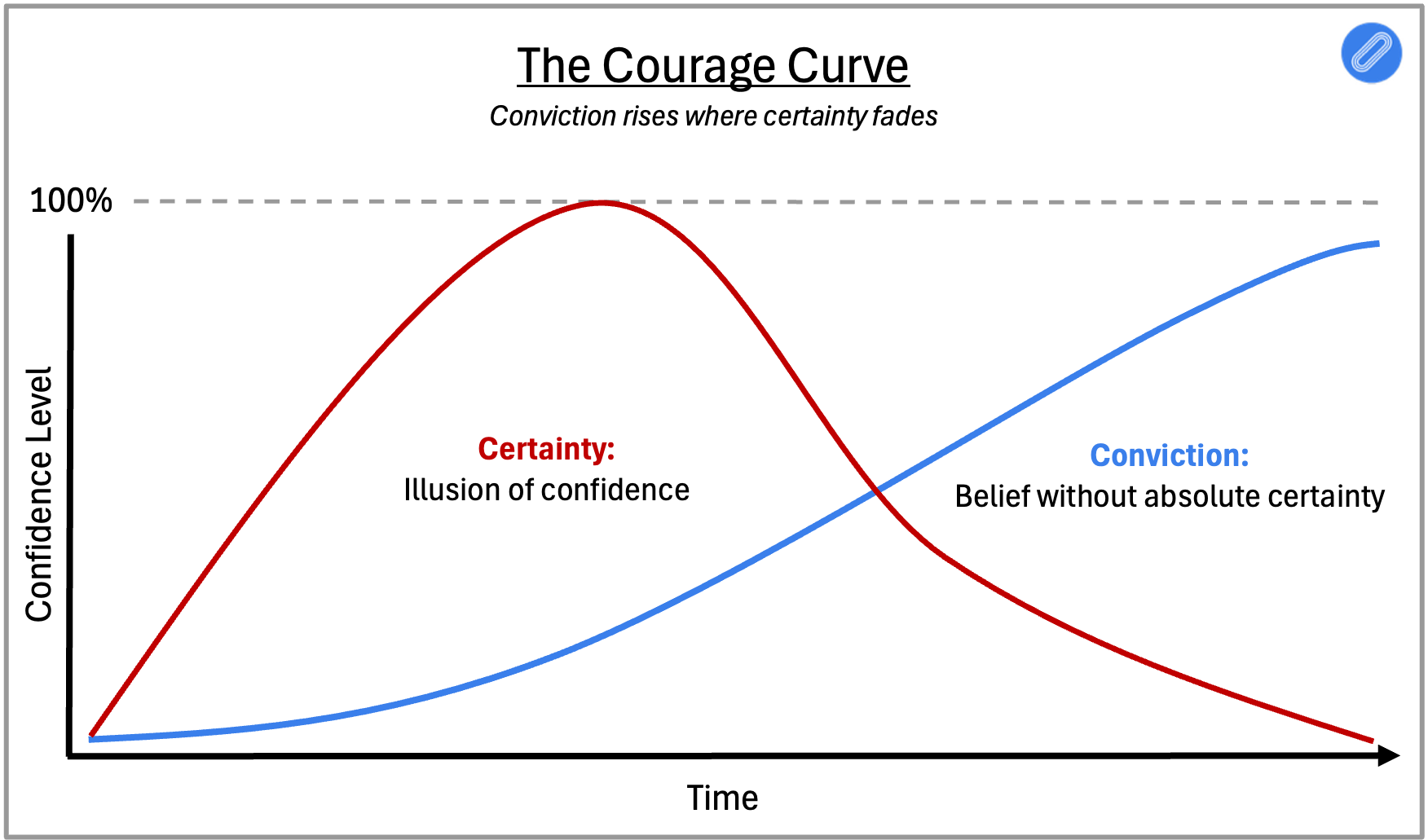
The key is to separate conviction from certainty.
Certainty implies prediction—the illusion of knowing the future.
Conviction is the willingness to express your best judgment despite not knowing.
Courage must always be matched by humility.
That’s why great investors rely on frameworks that turn courage into process:2
Kelly Criterion: The theoretical ideal for maximizing geometric growth.
It defines the optimal bet size given edge and odds—but assumes perfect knowledge.
In the real world, probabilities are blurry.
That’s why most use half-Kelly or less—humility in formula form.Volatility Scaling: Adjusting exposure as market stress rises.
It sacrifices some upside to survive volatility spikes—courage tempered by realism.Conviction Weighting: Allocating most capital to ideas least likely to lose money.
Weighting where the ground is firmest, not where the upside looks brightest.Risk Parity & Minimum-Variance Models: Quantifying fragility and prioritizing smooth compounding.
They remind us that staying solvent is the first victory.
Each framework asks the same enduring questions:
How much courage is enough—and when does it become reckless?
Executing Conviction
Here’s how disciplined investors translate conviction into action when certainty is absent:
Define the downside before the upside
Real conviction starts with clarity on what you can lose—both financially and emotionally.
The goal is to protect endurance, not just capital.Size by process, not emotion
The moment you feel sure, reduce the position.
Feelings aren’t a position-sizing tool; discipline is.Stay flexible as information changes
Conviction isn’t stubbornness.
The best investors resize as probabilities evolve.Distinguish between epistemic and aleatory uncertainty
Epistemic (knowable): can be reduced through learning.
Aleatory (random): can only be endured.
Courage lies in sizing each correctly—not confusing ignorance with randomness.3
Survive to stay right
Compounding only works if you’re still standing.
Never let ego size you out of the game.
Position sizing isn’t about maximizing return—it’s about maximizing longevity.
The Inner Game of Courage
Why is this so hard to practice?
Because the human brain confuses conviction with certainty.
We crave clarity, validation, and control—all things the market refuses to provide.
That’s why courage in investing looks steadier than people expect.
It’s not dramatic all-in bets or viral calls.
It’s patient scaling, controlled aggression, and the humility to protect against your own blind spots.
In probabilistic games like investing, courage without calibration is recklessness.
But calibration without courage is paralysis.
The great investors balance both.
They bet meaningfully when opportunity appears—and protect capital when uncertainty dominates.
They’re not braver because they feel less fear; they’re braver because they’ve built systems that let them act despite it.
The truth is, you’ll never have enough data to be certain.
But you can always design your exposure to be resilient.
And that’s what separates conviction from catastrophe.
The Measure of Courage
The goal isn’t to be right more often—it’s to be sized appropriately when you’re wrong.
Conviction, without the illusion of certainty, is what keeps you in the game long enough for compounding to work its magic.
In the end, position sizing is courage made measurable.
And courage, expressed through discipline, is what wealth is built on.
—Tobias
PS: I’ll be sailing for the rest of the year—but systems are running, and ideas will keep compounding here and on X.
Substack issues will publish every other week, though replies will be slower.
Back in January, with fresh perspective.
Before you go
Subscribe—start compounding today.
Share—pass the signal, not the noise.
Comment—invest in better conversations.
References
Maciej Wysocki — Sizing the Risk: Kelly, VIX, and Hybrid Approaches, 2025.
Walters, D. et al. — Investor Behavior Under Epistemic vs. Aleatory Uncertainty, 2023.